Lakurawa is rapidly expanding its territory and revenue in North West Nigeria, and may contribute to a long-feared bridge between Nigerian and Sahelian armed groups.
Violence linked to Lakurawa — an armed group in North West Nigeria that has reportedly pledged allegiance to Islamic State in the Greater Sahara (ISGS) — has surged since January 2025.1 It has caused dozens of fatalities,2 large-scale destruction of homes, and mass displacements in Sokoto and Kebbi.3 The increased violence, centred in the volatile region where Nigeria, Niger and Benin meet, could represent a worrying bridge for the expansion of Sahelian violent extremist groups into northern Nigeria.
Illicit economies fuel and sustain Lakurawa, and the group’s expansion into new territories brings greater access to critical revenue sources. The group generates income through cattle rustling, kidnapping, extortion under its self-imposed zakat (a form of almsgiving mandated in Islam) and the illicit oil trade, including vandalizing cross-border pipelines and seizing fuel supplies from black market traders.4 Illicit revenues strengthen the group’s operational capacity and further entrench its presence in the region.
This is in keeping with patterns across West Africa of armed groups engaging with illicit economies. As the findings of the 2025 Illicit Economies and Instability Monitor5 set out, armed groups in West Africa enter illicit economies for three main reasons: revenue generation; obtaining operational resources such as weapons, fuel or vehicles; and building legitimacy among the communities in which they operate. Lakurawa’s extortion of communities, imposing a form of extra-legal ‘governance’ to gather revenue and resources, shows that it is using this common playbook.
Lakurawa’s origins and expansion
Communities along the Niger–Nigeria border first encountered the group as armed herders — predominantly made up of Malian and Nigerien nationals — who frequently moved between communities in Sokoto State in 2017 and 2018.6 Initially perceived as a potential ally, some community leaders enlisted Lakurawa’s help to combat bandits who were destabilizing the region. Between 2018 and 2019, the group reportedly succeeded in pushing back these criminal elements.7
Stability was short-lived, however. After a dispute with one of the leaders who had sought its help, Lakurawa turned against the communities it had once protected. Between 2020 and 2022, the group became a predatory force, imposing levies, confiscating livestock, engaging in kidnappings and enforcing a rigid version of Islam. Some of the bandits dislodged by Lakurawa formed alliances with the group — not as formal members but as collaborators, particularly in cattle rustling and kidnapping operations.8
Lakurawa-linked events and evolution
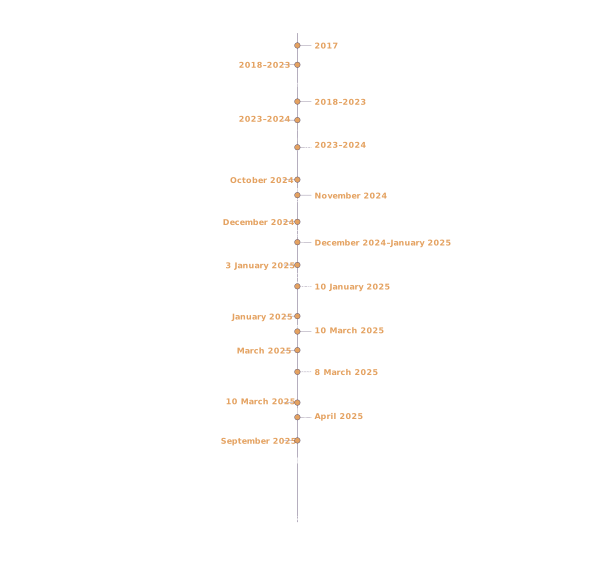
Figure 1 Lakurawa-linked events and evolution.
Source: Analysis of media reports and interviews with a cross section of vigilantes, community leaders and residents in Sokoto and Kebbi.
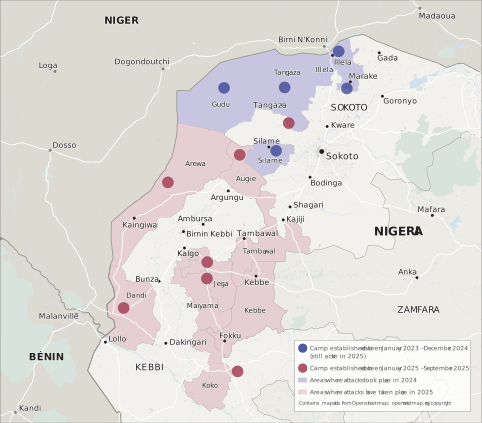
Figure 2 Lakurawa camps and violent attacks, November 2024–September 2025.
Source: Analysis of media reports and interviews with a cross section of vigilantes, community leaders and residents in Sokoto and Kebbi.
By the third quarter of 2024, Lakurawa had established permanent operational bases in Gudu and Tangaza, and its activities had expanded into parts of northern Kebbi.9 Since early September 2025, new camps have emerged in Jega, Maiyama and Koko (see Figure 2).10 Local sources report that with the establishment of these camps, the geographical scope of the group’s activities has increased, spreading into Kogi in the north-west, Kwara in the south-west and the Benin–Nigeria–Niger border area.11
An analysis by the Bonn International Centre for Conflict Studies estimates that the group has more than 1 000 fighters.12 This is likely to be a conservative estimate, as local sources report that the group has up to 700 members in two local government areas (LGAs) alone — about 500 in Gudu13 and 200 in Arewa.14
A bridge between Sahelian and Nigerian extremist groups
Evidence is mounting that Lakurawa is affiliated with ISGS. In July 2025, the UN sanctions monitoring team focused on Islamic State said: ‘Since late 2024, ISGS demonstrated its intention to shift activities towards the north-west border of Nigeria, relying on the Lakurawa group, which reportedly pledged allegiance to ISGS.’15
Lakurawa’s reported affiliation with ISGS poses a significant threat.16 While Islamic State West Africa Province (ISWAP) — another Islamic State affiliate with a strong and long-running presence in West Africa — has long operated in northern Nigeria, Lakurawa’s ties to ISGS increase the risks of a potential nexus between ISGS elements from the Sahel and extremist actors in Nigeria, creating a long-feared bridge between Nigerian and Sahelian groups. In practice, this could mean that operational resources, combatants and potentially finances could be shared with Lakurawa, and closer links established between ISGS and ISWAP in Nigeria. Lakurawa’s continued expansion into North West and North Central Nigeria represents a concerning development, reflecting the broader southward movement of extremist groups toward coastal West Africa. This trend is particularly alarming given that the region has historically remained relatively insulated from extremist influence and now risks becoming a hub for illicit revenue generation, with far-reaching implications for regional stability.
The Benin–Nigeria–Niger border area is home to a growing constellation of armed groups. The expansion of violent extremist groups from the Sahel towards the littoral states of West Africa is an emerging regional threat, with Nigeria increasingly exposed to this southwards shift.17 In this context, confronting the Lakurawa insurgency is vital for restoring stability within Nigeria’s borders and halting the broader trajectory of extremist encroachment into coastal West Africa. Disrupting Lakurawa’s sources of revenue is a crucial step in tackling the group’s growing influence and therefore mitigating the expansion and entrenchment of Sahelian extremist networks in northern Nigeria.
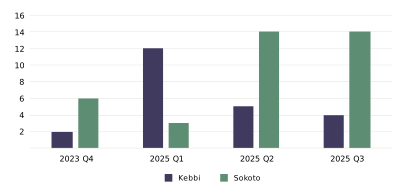
Figure 3 Incidents of violence linked to Lakurawa in Sokoto and Kebbi, 2023 and 2025.
Source: ACLED data
Lakurawa’s expanding revenue streams
Lakurawa’s access to resources increases as it establishes new operational bases and expands its activities to new areas. The group draws revenue from four key illicit economies — cattle rustling, extortion, kidnapping and the illicit oil trade.
Cattle rustling is the most lucrative and destabilizing activity. Between May and July 2025, more than 1 800 cattle were reported stolen in Sokoto’s Illela LGA, with Lakurawa and affiliated bandits responsible for the theft. In Augie LGA in Kebbi state, a vigilante noted that ‘about 2 000 cows and more than 1 500 sheep and goats’ were stolen within eight months in 2024.18
Previously, rustled cattle were sold in border markets in Niger, where they could fetch higher prices. However, recent border closures and stricter enforcement by Nigerien authorities have cut this key supply chain. In response, Lakurawa now moves rustled livestock to distant markets in southern Nigerian cities such as Lagos, Ilorin and Ibadan.19 This marks a strategic adaptation to international pressure, and it has given rise to a new class of brokers and dealers who travel into the forests to buy stolen livestock directly from Lakurawa for resale in urban centres. This emergent grey market illustrates how Lakurawa’s economic influence is not limited to remote borderlands but extends into mainstream commercial systems.
Explaining the group’s entrenchment and growing influence in the local cattle economy, a businessman in Gudu noted: ‘Our people have started business with them, especially cattle business. Their cattle are very cheap and available in our market.’20 In Augie, Lakurawa’s cattle rustling activities have devastated the cattle sector. According to a local source, some of the cattle dealers have ‘left the business’.21
Another important source of funds for Lakurawa is extortion. Under the guise of collecting zakat, they coerce farmers and herders into handing over livestock and other goods. This is a forced extraction process, a common strategy deployed by violent extremist organizations across West Africa. Thefts transform into zakat as a group’s level of influence over a territory increases.
Kidnapping for ransom is often conducted in collaboration with bandit groups. Previously a source of tension between Lakurawa and bandits, primarily due to disagreements on operational jurisdiction and revenue sharing, it has become a coordinated effort. Some of the bandits dislodged by Lakurawa have joined the group to perpetrate kidnappings since they have lost territorial control and need to sustain themselves.
Typically, a Lakurawa kidnapping involves members of the group storming into communities on motorcycles. They shoot and kill anyone who resists or whom they suspect is a vigilante, and abduct those they think are wealthy enough to pay a ransom. For example, in coordinated attacks targeting communities in Kebbe and Tambuwal LGAs, an unknown number of residents were kidnapped and scores were killed in September 2025.22
Fuel theft is another revenue stream. On 13 December 2024, the Niger–Benin oil pipeline was attacked in Dosso Region, Niger, allegedly by Lakurawa fighters. Nigerien authorities alleged that the militants attacked with the backing of Nigerian forces. The federal government of Nigeria denied this, emphasizing that the country is committed to countering violent extremism in the region.23
Though media reported Lakurawa’s vandalizing of the Niger–Benin oil pipe as primarily an act of sabotage, local sources suggested it had a strong economic motivation.24 The group regularly siphons fuel from Niger–Benin pipelines passing through its area of operations and sells it to buyers from Niger. This is often accompanied by targeted sabotage of the pipelines, possibly to mask the thefts or to assert control over critical infrastructure.25
There were at least six attacks on the Niger–Benin oil pipelines between December 2024 and May 2025.26 While in Sokoto, the group mainly taps fuel from cross-border pipelines. In Kebbi, where there are no such pipelines, a vigilante leader described how they ‘steal fuel from black marketers and filling stations’.27
Anti-Lakurawa strategy must target its income streams
Lakurawa’s diversified economic base sustains its operations and enables the group to adapt to shifting conditions, such as the impact of border closures on its role in the cattle rustling market.
In some ways, Lakurawa’s exploitation of illicit economies is a textbook example of trends seen across illicit hubs in West Africa.28 Through cattle rustling and kidnap for ransom, the group builds the revenue it needs. Through fuel theft, it can amass revenue and access a resource it needs to conduct operations. Through zakat and extortion, as well as kidnappings, it enforces its image as a feared group and builds legitimacy as a power broker.
Yet in other ways, it is a unique actor in the Nigeria–Niger border region. Its relationship with ISGS may transform the role of Sahelian armed groups in northern Nigeria. Through this lens, its embedded role in illicit economies such as cattle rustling, extortion and kidnapping is a concerning development. These are markets that the Illicit Economies and Instability Monitor analysis has found to have an ‘accelerant’ effect on instability and conflict.29 Any effective strategy to weaken Lakurawa must therefore target its income streams to disrupt the group’s financial ecosystem.
Notes
-
UN Security Council, Letter dated 21 July 2025 from the chair of the Security Council committee pursuant to resolutions 1267 (1999), 1989 (2011) and 2253 (2015) concerning Islamic State in Iraq and the Levant (Da’esh), Al-Qaida and associated individuals, groups, undertakings, July 2025. ↩
-
Isad Ismaila, Six-month killing spree: Lakurawa terrorists leave 59 dead in north-west Nigeria, HumAngle, 21 June 2025. ↩
-
Sahara Reporters, Lakurawa terrorists kill Sokoto community leader, one other in fresh attack, 20 September 2025. ↩
-
Interview with Sokoto-based security expert, 1 October 2025. ↩
-
Lyes Tagziria and Lucia Bird, Illicit economies and instability: Illicit hub mapping in West Africa 2025, GI-TOC, October 2025. ↩
-
Interviews with vigilantes and residents in Sokoto and Kebbi, September 2025. ↩
-
UN Institute for Disarmament Research, The Lakurawa: North-west Nigeria’s ‘newest’ threat, 26 March 2025. ↩
-
Interview with vigilante leader in Augie, 14 September 2025. ↩
-
Shola Lawal, Lakurawa, the new armed group wreaking havoc on the Nigeria-Niger border, Al Jazeera, 10 January 2025. ↩
-
Interview with Sokoto-based security expert, 1 October 2025. ↩
-
Ibid; interview with vigilante leader in Augie local government area of Kebbi, 14 September 2025. ↩
-
Mustapha Alhassan, Oyewole Oginni and Claudia Breitung, Countering Lakurawa recruitment in north-west Nigeria, Bonn International Centre for Conflict Studies, September 2025. ↩
-
Interview with businessman in Gudu, 13 September 2025. ↩
-
Interview with youth leader in Arewa, 14 September 2025. ↩
-
UN Security Council, Letter dated 21 July 2025 from the chair of the Security Council committee pursuant to resolutions 1267 (1999), 1989 (2011) and 2253 (2015) concerning Islamic State in Iraq and the Levant (Da’esh), Al-Qaida and associated individuals, groups, undertakings, July 2025. ↩
-
UN Institute for Disarmament Research, The Lakurawa: North-west Nigeria’s ‘newest’ threat, 26 March 2025. ↩
-
Center for Preventive Action, Violent extremism in the Sahel, 4 September 2025. ↩
-
Interview with vigilante leader in Augie LGA, Kebbi, 14 September 2025. ↩
-
Ibid. ↩
-
Interview with businessman in Gudu local government area, Sokoto, 13 September 2025. ↩
-
Interview with vigilante leader in Augie LGA, Kebbi, 14 September 2025. ↩
-
Musa Ubandawaki, Communities flee, village head in exile as Lakurawa, bandits, kidnappers sack villages in Sokoto, Vanguard, 16 September 2025. ↩
-
Ojochenemi Onje, Nigeria denies allegations of involvement in Niger oil pipeline attack, Business Day, 21 December 2024. ↩
-
Ibid. ↩
-
Interview with vigilante leader in Illela, Sokoto, 13 August 2025. ↩
-
Goro Initiative, Niger: Satellite images reveal possible oil spills following pipeline attack, 19 January 2025; Zagazola Makama, Pipeline attacked again near Konni in Niger Republic, Zagazola, 9 May 2025 ↩
-
Interview with vigilante leader in Augie, 14 September 2025. ↩
-
Lyes Tagziria and Lucia Bird, Illicit economies and instability: Illicit hub mapping in West Africa 2025, GI-TOC, October 2025. ↩
-
Ibid. ↩