Cinkassé cattle market in Togo — closed due to fears it was being used to launder stolen cattle — reopened under strict reforms, but risks persist.
Cattle rustling has become a defining feature of the Sahel’s war economy, used by armed groups to build financing and legitimacy among communities. The GI-TOC’s 2025 illicit hub mapping data highlighted cattle rustling as one of the criminal markets most fuelling instability (termed an ‘accelerant market’) in the Sahel and West Africa: it is prevalent in 15 of the 23 hubs that play the most significant role in regional instability.1
Since 2015, central Mali and Burkina Faso have been the epicentre of conflict and cattle rustling. The criminal ecosystem crosses borders, however, and coastal states are key hubs for laundering stolen livestock. In northern Togo’s Savanes region, Cinkassé has long operated as a key trading hub. The cattle market in Cinkassé, which is on the border with Burkina Faso and Ghana (the tri-border area), became one of the main hubs for licit and illicit livestock trade, particularly after Togolese authorities closed the Koudjouaré market, further east near the Benin border, for security reasons in 2022.
Since 2022, violent extremist organizations (VEOs) — predominantly Jama’at Nasr al-Islam wal Muslimin (JNIM) — have gained ground in the borderlands between south-eastern Burkina Faso and the Savanes region, and violence has surged. In Savanes alone, Armed Conflict Location & Event Data (ACLED) shows an increase in violent incidents associated with extremism from one between 2020 and 2021, to 60 between 2022 and 2024.2
In parallel, cattle rustling increased and transformed from small, largely non-violent thefts — typically linked to community members or banditry — to violent looting of entire herds, often linked to JNIM.3 The hub mapping initiative tracks a rise in cattle rustling in the northern areas of Benin and Togo — both increasingly heavily affected by JNIM activity. This mirrors trends throughout regional conflict zones: areas infiltrated by JNIM see rising rates of cattle theft and a transformation of the criminal economy.4
After seizing the livestock, JNIM relies on a vast network to sell them. Through a complex chain of intermediaries, stolen livestock is either sold on regional markets in northern areas of coastal states (such as Côte d’Ivoire and Togo) or on small black markets (mostly in Ghana), then brought further south to large consumer markets. While these are mostly in central or southern regions (including the capitals), the big regional livestock markets are often closer to border areas, enhancing their vulnerability to infiltration by armed group intermediaries.5
JNIM’s growing infiltration has driven changes in illicit economies beyond cattle rustling, transforming Cinkassé’s criminal ecosystem. Togo is a primary import and transit area for goods from its large maritime port destined for landlocked Sahelian countries. As the point through which almost all trade — licit and illicit — passes on its way north, Cinkassé has long been a key trading node.
The 2022 and 2025 iterations of the illicit hub mapping data track how Cinkassé developed from a general illicit trade hub to an ecosystem in which VEOs — especially JNIM — are more embedded in local economies and logistics.6 Until 2022, the main concern — reflected in the findings of the 2022 hub mapping — was the potential role of trafficking networks in facilitating extremist group activities and entrenchment in the area, as they have done in other coastal borderlands, including in the W-Arly-Pendjari Complex on the nearby Benin–Burkina Faso–Niger border.7 By 2025, the illicit hub mapping shows that JNIM was operating in northern Togo and fully relying on Cinkassé as a key node for resourcing and financing, in particular trading in motorbikes, fuel and cattle.8
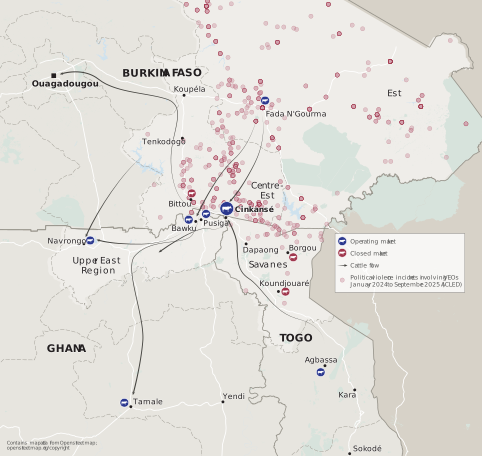
Figure 1 Cattle trade flows, market closures and insecurity in the tri-border area of Togo, Burkina Faso and Ghana.
Source: Based on data collected by the GI-TOC, Acting For Life and ACLED
Attempts to curb laundering on regional markets
Mirroring approaches adopted elsewhere in the region, the Togolese state responded to the changing criminal environment in Cinkassé with restrictions. It curbed informal fuel sales9 and, crucially, closed the town’s cattle market in October 2024. Government spokespersons said the market was an important JNIM node for laundering stolen animals and a key source of financing for the group.10
Cattle markets across West Africa have come under intense pressure from authorities seeking to block financial flows to armed groups. Cattle trade nodes now play a key role in the counter-insurgency strategies of national authorities.11 In Mali, several large Bamako markets were temporarily closed in September 2024 after a deadly JNIM attack on the capital. In Burkina Faso’s Est region, the last large cattle market in the regional capital of Fada N’Gourma is under pressure. The Burkinabe minister of security visited the market in late 2024 to discuss how to prevent insurgents from accessing it.12 Market closures are not specific to the Sahel and are not a new strategy. In north-east Nigeria, the authorities closed cattle markets as early as 2016 to cut financing to Boko Haram, while in the north-west Zamfara state dozens were closed between 2018 and 2022.13
The strategy of cutting off resourcing and financing to VEOs extends well beyond cattle rustling and is part of a broader policy trend. In West Africa and the Sahel, this logic has increasingly been applied to operational supply chains, with measures targeting commodities such as fuel, motorbikes and even gold, on the assumption that restricting access will weaken armed groups. However, these approaches carry similar risks across contexts: they often fail to account for the adaptive strategies of armed actors while imposing severe costs on communities who rely on the same flows for their livelihoods.14
Since 2022, authorities in Togo have temporarily or permanently closed all primary markets in Savanes, including Koudjouaré and Borgou, as JNIM infiltrated and stepped up attacks in the region. The closures have had significant consequences for pastoralists, traders15 and the wider economy: markets generate municipal taxes and fees for local authorities, and sustain linked economic activities such as transportation, food and water vending, fodder sales, and informal jobs for intermediaries and loaders.16
Further, the closure of markets does not eliminate the laundering of stolen cattle. Instead, it displaces the trade into informal settings (such as black markets), where transactions are even less regulated and more opaque.17
The Cinkassé experiment
A month after the October 2024 closure of the Cinkassé market, negotiations between the market management committee and the authorities led to its reopening. Under state pressure, the management committee introduced measures to tighten traceability, ensure stricter control of transactions and facilitate stronger oversight by the authorities, including the defence and security forces.18 The measures include:
- Halving the number of registered brokers allowed to operate in the market, from more than 40 to 21, selected on the basis of peer trust and reputation.
- Registering brokers and issuing them with badges, making transactions easier to monitor.
- Registering traders who want to sell animals in the market and requiring them to produce identification.
- Mandating standardized receipts for all sales, which include the name of the broker, and the number and breed of animals.
- Sharing copies of receipts with the authorities (including police and gendarmerie at checkpoints) so they are informed of movements in and out of the market.
- Checking receipts and livestock headcounts at checkpoints as traders move out of the market.
- Restricting movements of cattle in and out of the market to daytime.
Taken together, these reforms constitute one of the most ambitious attempts yet to regulate a regional cattle market. They have succeeded in safeguarding business at the market: in the first eight months of 2025, 23 000 animals were sold in Cinkassé, 59% more than the 14 500 sold in 2024, when the trade was affected by insecurity at the Burkinabe border and limitations (culminating in the October closure) imposed by the authorities.19
As of October 2025, a year after the market’s month-long closure, local authorities, the market committee and security forces all describe the reforms as credible safeguards against the laundering of cattle stolen by JNIM. They have closed three main loopholes through which stolen livestock previously entered the market. First, the sharp reduction in the number of brokers has limited the space for more opportunistic intermediaries — particularly younger brokers once suspected of facilitating shady sales. Second, stricter documentation rules — and investigations whenever there is doubt about an animal’s provenance — have raised the costs and risks of attempting to introduce stolen cattle. Third, the ban on night-time livestock movements means transactions occur only during official market hours, under the eyes of the committee and security forces. Together, these measures are seen as closing the vulnerabilities that groups such as JNIM-linked intermediaries once exploited, while improving compliance and transparency.20 Importantly, there is no evidence of parallel markets emerging or of traders avoiding Cinkassé; instead, sales have increased.21
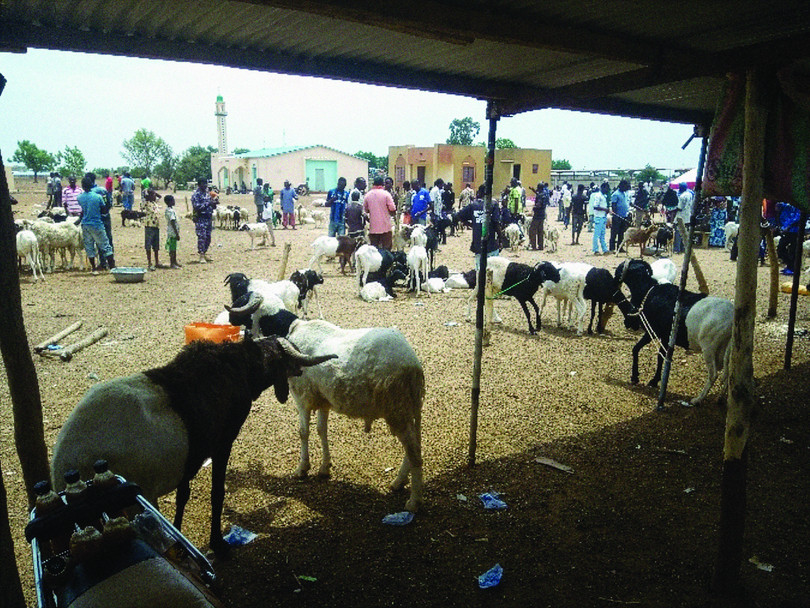
The Cinkassé cattle market in Togo is a key example of efforts to reform markets previously exploited by illicit actors.
Nevertheless, the model is not bulletproof. Some brokers still bypass receipts, and ongoing sensitization and strict enforcement are key to ensuring compliance does not diminish. More fundamentally, Cinkassé’s success cannot entirely insulate the trade from cattle stolen further upstream. Stolen livestock may still be laundered earlier in the chain, particularly in markets in Burkina Faso, before reaching the border. For many, the lesson is that the practices piloted in Cinkassé should ideally be extended across the wider market network.
The lesson from Cinkassé is clear: strong regulatory pressure, when combined with inclusive local engagement, can transform a market rather than shut it down. Market closures may appear to be a quick security fix but they deprive communities and states of revenue while pushing trade into informal settings, failing to curb the threat that triggered them. By contrast, negotiated reforms, backed by the credible threat of closure, can align incentives for better traceability. Authorities from neighbouring coastal and Sahelian states should therefore consider Cinkassé as a model for how to curb laundering of stolen animals and financing streams to violent extremist organizations.
Notes
-
Lyes Tagziria and Lucia Bird, Illicit economies and instability: Illicit hub mapping in West Africa 2025, GI-TOC, October 2025. ↩
-
ACLED, Data Export Tool. ↩
-
For a deeper analysis of cattle rustling in this area see James Courtright and Kars de Bruijne, Cattle Wahala: How Ghana, Burkina Faso and Togo can jointly address the political economy of cattle rustling and smuggling in the tri-border region, Clingendael, 8 July 2025. ↩
-
Flore Berger, Locked horns: Cattle rustling and Mali’s war economy, GI-TOC, March 2023. ↩
-
Flore Berger, Cattle rustling and insecurity: Dynamics in the tri-border area between Burkina Faso, Côte d’Ivoire and Ghana, GI-TOC, July 2025. ↩
-
This is done by comparing 2022 and 2025 hub mapping data. ↩
-
Antônio Sampaio et al, Reserve assets: Armed groups and conflict economies in the national parks of Burkina Faso, Niger and Benin, GI-TOC, May 2023. ↩
-
Lyes Tagziria and Lucia Bird, Illicit economies and instability: Illicit hub mapping in West Africa 2025, GI-TOC, October 2025. ↩
-
Edouard Samboe, Interdiction du carburant frelaté: Les reconvertis tentent de joindre les deux bouts, Laabal, 13 August 2024. ↩
-
27avril, Togo: Fermeture du marché de Cinkanssé: une économie locale asphyxiée, 8 November 2024. ↩
-
Bernard Bonnet and Sergio Dario Magnani, Défendre les droits des acteurs du commerce régional de bétail face à l’insécurité et aux crises sécuritaires, Permanent Interstate Committee for Drought Control in the Sahel, 2021. ↩
-
James Courtright, How stolen cattle links Ghana to the jihadist conflict in the Sahel, The New Humanitarian, 16 July 2025. ↩
-
Kingsley L Maduke, Driving destruction: Cattle rustling and instability in Nigeria, GI-TOC, January 2023. ↩
-
GI-TOC, Pitfalls in responding to armed groups’ supply chains: lessons from Cameroon and the Sahel, Risk Bulletin 10, January 2024. ↩
-
Jeune Afrique, Entre gouvernement et jihadistes, les marchés aux bestiaux du nord du Togo, au cœur d’un casse-tête sécuritaire, 15 July 2025. ↩
-
27avril, Togo: Fermeture du marché de Cinkanssé: une économie locale asphyxiée; Zana Coulibaly, Livestock markets: a goldmine for local authorities?, Acting for Life, 25 October 2022. ↩
-
Workshop in Lomé with representatives of management market committees, pastoral organizations and authorities of the tri-border area between Ghana, Togo and Burkina Faso, July 2025. ↩
-
Ibid. ↩
-
Statistics provided by Acting For Life as part of its monitoring of key livestock infrastructure. ↩
-
Follow-up interviews to the Lomé workshop with representatives of management market committees, pastoral organizations and authorities of the tri-border area, September 2025. ↩
-
Ibid. ↩