
Arms trafficking routes into northern Mali have been disrupted. Why has this happened and what are the implications?
Arms trafficking routes into and through northern Mali have undergone major changes since mid-2023. This disruption was triggered, in part, by a major northward offensive into rebel-held territory led by the Malian Armed Forces (FAMa) and their then partners, the Russian Wagner Group (now replaced by the Africa Corps), between August and November 2023. This caused an upsurge of violence in northern Mali and intense clashes between government forces and rebel groups.
As a result, established arms trafficking routes into northern Mali have become less viable, prices for illicit arms have significantly increased and new routes connecting to other regions (such as northern Nigeria) have started to emerge. At the same time, new types of weapons are being smuggled into northern Mali and stockpiles of weapons from new sources — such as spillover from the conflict in Sudan — may be starting to emerge.
Changes in the arms trafficking landscape have wider implications for stability in the central Sahel. The GI-TOC’s 2025 West Africa illicit hub mapping initiative identifies the arms trade as one of five ‘accelerant’ illicit economies (with cattle rustling, kidnapping, the gold trade, and extortion and protection racketeering): markets that play a significant role in shaping the regional conflict landscape.1 As part of the mapping, the Illicit Economies and Instability Monitor (IEIM) was developed as an expert-led tool that provides a quantitative assessment of how illicit economies in each hub fuel violence and instability. Data from the 2025 iteration of the IEIM shows that arms trafficking features in three-quarters of all the West Africa hubs that play a significant role in fuelling instability.2 Disruptions to the Malian arms trafficking market shape how the country’s extremist and insurgent groups arm themselves, with far-reaching consequences for the broader conflict landscape.
Disruption along established arms trafficking routes
In addition to bringing territory back under government control — including towns such as Kidal, Ber and Anéfis3 — the 2023 offensive disrupted a range of licit and illicit flows of commodities, including weapons. This restructure of territorial control in northern Mali disrupted longstanding arms trafficking routes from Libya, traversing southern Algeria, which have historically fed into northern Mali. (Libya is a major source country for arms used in conflicts across the Sahel.)
Trafficking networks face increased risks along these established routes. Increased air surveillance and drone strikes, and military presence on the ground along key roads and in towns, must be navigated to reach destination markets. Violence in northern Mali has remained intense throughout 2025, through terrorist attacks targeting FAMa positions, banditry on main roads and clashes between armed groups.4
The disruption is also due to renewed government control of key towns that were historically arms trading hubs.5 Trafficking networks with close links to armed groups — and dependent on their protection — can no longer operate freely there.6 For instance, Ber was a key market and storage point for licit and illicit goods, including consumer products such as fuel smuggled from Algeria; stolen and hijacked vehicles; narcotics en route through northern Mali; and gold from the Kidal and Gao regions.7 Under the influence of armed groups — including what was then known as the Strategic Framework for the Defence of the People of Azawad, a coalition of political and military movements in northern Mali, and Jama’at Nusr al-Islam wal Muslimin (JNIM), the al-Qaeda affiliate and the most active violent extremist organization in the Sahel — traffickers could store and sell their wares openly.
In August 2023, Ber’s role as a hub for arms trafficking ended when FAMa seized the town, forcing armed groups and their associated traffickers to withdraw. The town could no longer act as an entrepôt for illicit wares in the same way, but it remains a hotspot for less sensitive illicit activities, such as the sale of contraband consumer goods and synthetic drugs.8 Sources in the region suggest that other towns, similarly known as hotspots along arms trafficking routes, have likewise become less active.9 This is reflected in data gathered for the IEIM. Arms smuggling scores collected at hubs across northern Mali — such as Foïta, Lerneb and Taoudeni — all decreased between the 2022 iteration of the IEIM and the latest set of data.
This has driven up the prices of arms in the illicit market and led to the emergence of alternative arms trafficking routes. Data on prices offered for illicit arms points to significant increases on markets in northern Mali, suggesting low supply and high demand. Drawing on interviews with arms dealers, intermediaries and members of armed groups, this increase in arms prices can be traced back to around 2022.10 As international forces such as France’s Operation Barkhane withdrew, violence intensified between armed groups and demand for weapons increased.11 This demand continued in 2023 due to the northward offensive, causing prices to increase further. In 2025, prices have stabilized but remain high. Data collected in Gao, Menaka and Kidal in February and August 2025 showed that prices remained at a similar level.12
In February, the price of an AK-47 in Gao rose to about CFA600 000 (about €920), compared to CFA200 000–CFA300 000 (€300–€450) before Wagner and FAMa’s northern offensive. AK-47 prices in Gao were even higher in August. Near the Mauritanian border, they were between CFA900 000 and CFA1 million (€1 370–€1 520) for a similar weapon.13 AK-47s in this region reportedly sold for CFA600 000–CFA700 000 in 2023. The same change is seen in ammunition for AK-47 rifles, sold for CFA800–CFA1 000 (€1.20–€1.50) per unit before 2023 but now costing CFA1 250–CFA1 500 (€1.90–€2.30) in the Mauritanian border region.14 AK-47s and small arms (such as Makarov PM pistols and Kalashnikov PKM general-purpose machine guns) remain the most common weapons sold, especially in large towns. Higher-calibre weapons (such as heavy machine guns, anti-tank rifles and rocket-propelled grenades) are also available but are sold more discreetly.
In addition to supply chain disruption, a range of factors are driving increased demand for weapons, pushing up prices. There is sustained demand from Mali’s myriad armed groups — who arm themselves through illicit supplies and arms seized from government forces — but other drivers of demand are more counterintuitive. The Malian government recently announced a new disarmament, demobilization and reintegration process, aiming to reintegrate armed groups into the Malian armed forces.15 In 2018, when a previous iteration of this process was haphazardly implemented, the demand for arms increased.16 Individuals sought to ‘mobilize’ by buying weapons in order to participate in the process, and armed groups swelled their ranks so they could ‘demobilize’ combatants without meaningfully reducing their military capabilities. Sources in the national commission launched to manage this process, and members of the political Movement for the Salvation of Azawad (MSA), suggest that this is happening again.17
Armed groups find new routes and weapons for arms trafficking
One of the effects of this disruption has been that armed groups are seeking alternative routes. For example, several sources report that a route linking northern Nigeria to northern Mali via Niger is becoming important, particularly for Islamic State Sahel Province (IS Sahel). According to a source close to the group, senior IS Sahel leaders reportedly travelled to Nigeria in late 2024 and early 2025 to cement links with Islamic State West Africa Province (ISWAP) insurgents and to strengthen mutual supply networks.18 This may result in more arms being supplied by ISWAP to their IS Sahel allies in Mali and represents a change from previous trends in arms trafficking routes: arms have been more commonly trafficked from Sahelian states into Nigeria, rather than the other way around, as the new information suggests. Niger has faced a surge in Islamic State-linked violence in 2025. According to a Human Rights Watch report, nearly 130 people were ‘summarily executed’ by Islamist insurgents in attacks between March and September.19
While established arms trafficking routes from Libya into northern Mali have been disrupted, weapons are still trafficked along these (now riskier) roads, albeit in smaller volumes than before. It appears that armed groups seeking to supply drones and drone parts are using these same routes from Libya.
Arguably, the most important shift in illicit arms markets in Mali and the Sahel has been the emergence of drone warfare in the past two years. Surveillance drones and attack drones, including so-called ‘kamikaze’ drones where the drone is itself the missile, have become widely used by armed groups across the Sahel, such as JNIM and the Azawad Liberation Front (FLA), a coalition of Tuareg separatist groups that seeks independence or autonomy for the Azawad region in northern Mali.20 This has been described by observers as ‘the fastest period of innovation uptake in the history of asymmetric warfare’.21 Footage from so-called first-person view drones is widely relayed on social media to rebel supporters and the wider world.22
For example, on 23 August and 5 September 2025, the FLA launched two drone attacks on FAMa and Africa Corps camps in Tessalit, in the Kidal region.23 In both cases, footage from the first-person view drones was circulated on social media. After the August attack, the Africa Corps claimed there had been no casualties and published an image of the alleged wreckage of the drone online. These are among the latest in a series of similar attacks claimed by the FLA.
These new weapons are sourced on the same routes as conventional arms. According to an FLA official, drones, their explosives and parts are mainly sourced from Libya. He suggested that fighters are also trained in Libya to use drones.24 Previous media reports have suggested that the proliferation of drones in the Sahel is an indication of support and training supplied by Ukrainian special forces, particularly to counter Russian mercenaries in Africa.25
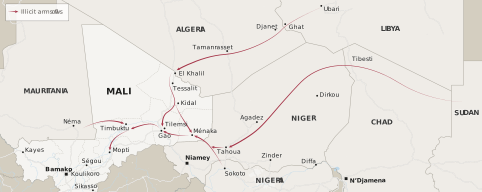
Figure 1 Illicit arms flows to northern Mali, as of September 2025.
Similarly, the war in Sudan has triggered an uptick in arms flows around the Sahel. These include flows into Sudan from external sponsors of the conflict who have channelled material via Libya and Chad; and outbound flows as arms destined for Sudan spill over into the wider region. While most of this spillover remains in neighbouring Chad and Libya, GI-TOC research suggests that since late 2024 some weapons have been ending up further afield, in Niger and Mali. These arms are moved through the Tibesti region of northern Chad26 or key trading hubs in southern Libya, such as Ubari and Ghat, via the Salvador Pass smuggling route into northern Niger.27
Tuareg networks, which have familial and trade links across Mali and Niger, are instrumental in supplying armed groups in northern Mali.28 These networks are involved in moving arms south through the Salvador Pass into northern Niger, ultimately reaching northern Mali.29 Other sources have suggested that JNIM, rather than relying on Tuareg networks to source arms, has individuals dedicated to purchasing weapons in Ubari and transporting them to northern Mali. Similarly, the FLA reportedly sends individuals to buy weapons and return them to areas under its control.30
Effects of disruption in illicit arms markets
Mali’s restricted supply of illicit arms in a context of sustained high demand may have hard-to-predict consequences. Some actors may be incentivized to sell surplus weapon stockpiles, putting more illicit merchandise into circulation. Sources report that some JNIM members have opportunistically sold weapons looted during clashes or seized from government stockpiles.31 In the Gao and Kidal regions, in particular, JNIM is using gold mining areas it has access to — including the biggest gold mine in northern Mali, N’thaka — as markets for the trade of illicit goods, including weapons.32 This is confirmed by several gold miners from the area.33 It is not clear whether JNIM’s arms sales to gold mining groups are prompted by high prices or simply by the need to shed supplies that JNIM fighters do not need. Interviews with members of armed groups have indicated that certain FAMa troops are illegally selling state weapons.34 Similarly, it is unclear if high prices provide an incentive for this or if it is merely a continuation of FAMa’s poor arms control, which has been observed in previous years.
The illicit arms trade is an ‘accelerant’ market because it provides the arms, ammunition and materiel needed to allow conflict to continue. Increases in arms prices in northern Mali and emergence of different routes for bringing in weapons to armed groups are indications of consistent demand for arms. They also show the connections between violent extremist organizations in Mali and groups in the broader region. These links can help reinforce and strengthen armed groups in the face of arms supply disruption, government offensives and intensified surveillance within Mali.
Notes
-
Lyes Tagziria and Lucia Bird, Illicit economies and instability: Illicit hub mapping in West Africa 2025, GI-TOC, October 2025. ↩
-
Ibid. ↩
-
Morgane le Cam, Malian army drones strike Kidal, northern rebel stronghold, Le Monde, 9 November 2023. ↩
-
International Crisis Group, CrisisWatch, August–September 2025. ↩
-
Lyes Tagziria and Lucia Bird, Illicit economies and instability: Illicit hub mapping in West Africa 2025, GI-TOC, October 2025. ↩
-
Interviews with weapons traders in Mauritania border region, February 2025. ↩
-
Lyes Tagziria and Lucia Bird, Illicit economies and instability: Illicit hub mapping in West Africa 2025, GI-TOC, October 2025. ↩
-
Ibid. ↩
-
Interviews with weapon traders in Mauritania border region, February 2025. ↩
-
Interviews with arms trade intermediaries in Gao, Menaka and Kidal, February 2025 and August 2025. ↩
-
Ibid. French forces under Operation Barkhane withdrew in August 2022. ↩
-
Ibid. ↩
-
Interviews with weapon traders, self-defence groups and miners, Gao, February 2025. ↩
-
Field interviews with weapon traders in Mauritania border region, February 2025. ↩
-
Radio France Internationale (RFI), Mali: des combattants des groupes alliés à la Transition vont être intégrés dans l’armée, 12 February 2025. ↩
-
Lucia Bird and Lyes Tagziria, Organized crime and instability dynamics: Mapping illicit hubs in West Africa, September 2022. ↩
-
Interviews with sources in the national commission managing the disarmament, demobilization and reintegration process, and members of the MSA, August–September 2025. ↩
-
Interviews with a source linked to Islamic State, September 2025. ↩
-
Human Rights Watch, Niger: Islamist armed group executes civilians, burns homes, 10 September 2025; Wycliffe Muia and Chris Ewokor, Jihadists ‘summarily executed’ 127 people in Niger, says rights group, BBC, 10 September 2025. ↩
-
Rida Lyammouri and Niccola Milnes, Countering JNIM’s drone proliferation in the Sahel, Policy Center for the New South, 14 July 2025. ↩
-
Rida Lyammouri and Niccola Milnes, Drone warfare and cartel convergence in West Africa: Risks to American safety, security, and prosperity, Policy Center for the New South, 19 September 2025. ↩
-
Benjamin Roger and Emmanuel Grynzspan, Dans le nord du Mali, les drones ukrainiens éclaircissent l’horizon des rebelles, Le Monde, 10 October 2024. ↩
-
Examples of the footage shared on social media: example 1, example 2. ↩
-
Interview with FLA official, September 2025. ↩
-
Benjamin Roger and Emmanuel Grynzspan, Dans le nord du Mali, les drones ukrainiens éclaircissent l’horizon des rebelles, Le Monde, 10 October 2024. ↩
-
Collateral circuits: The impact of Sudan’s war on arms markets and mercenary networks in Chad and Libya, GI-TOC, forthcoming. ↩
-
Interviews with observers (LY3 and LY4) in Fezzan, Libya, April 2025. ↩
-
Hassane Koné, July 2022, Arms trafficking from Libya to Niger is back in business, Institute for Security Studies. ↩
-
Ibid. ↩
-
Interview with observer (LY4) in Fezzan, Libya, April 2025. ↩
-
Interview with arms trade expert, June 2025. ↩
-
Interview with a local observer of JNIM activities in Kidal, September 2025. ↩
-
This is confirmed by several gold miners and elements of the armed groups active in the area, August–September 2025. ↩
-
Interview with MSA member in Ansongo, February 2025. ↩