Western Balkan criminals are fuelling London’s illicit tobacco trade.
Between the second half of 2024 and April 2025, authorities in Kosovo conducted an investigation into cigarette smuggling through Pristina International Airport. The operation exposed a trafficking route that was being used by nationals from several Western Balkan countries to supply the illicit tobacco market in London.1 The probe began after three UK nationals of Iranian origin, who had previously been suspected of theft, were flagged by airport officials. They were then subjected to an additional luggage inspection before boarding their flight to London Luton Airport.
The passengers were found to be in the possession of 190 cartons of cigarettes. One individual was carrying 64 cartons that had been purchased at the airport’s duty-free shop, which far exceeded the legal limit of one carton per person.2 The case raised questions about compliance and oversight within retail operations at Pristina airport, as the acquisition of such a large quantity of tobacco products strongly suggested complicity or negligence among the staff.
The incident prompted an escalation in security and an intensified information exchange with customs authorities in several countries — including the UK — in order to identify additional suspects and establish smuggling patterns.3 Border authorities, including the police, customs and Kosovo’s National Centre for Border Management, launched joint operations, partly based on risk assessments of outbound passengers. The limited presence of customs officials at Luton airport, particularly in the late evening, was identified by Kosovan border authorities as a major factor contributing to cigarette smuggling attempts by passengers.4
Between July 2024 and April 2025, authorities at Pristina airport identified 18 smuggling attempts and seized a total of 1 510 cartons of cigarettes.5 Passengers found with stamped cigarettes were issued misdemeanour fines, while those carrying unstamped cartons faced criminal charges.6 The smuggling of unstamped cigarettes suggests a greater likelihood of organized criminal activity, which often extends to the illegal production of tobacco. The absence of a stamp also makes it more difficult to determine the country of origin, the networks involved and the routes taken.
| Year | Cases | Cartons |
|---|---|---|
| 2024 | 7 | 596 |
| 2025 | 11 | 914 |
Figure 1 Cigarette seizures at Pristina International Airport (flights destined for London).
Source: Kosovo Customs
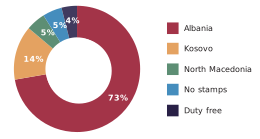
Figure 2 Origin of cigarettes seized at Pristina International Airport.
Source: Kosovo Customs
In several cases, smugglers attempted to bypass controls by placing only a few cartons in their hand luggage, or none at all, in the hope of avoiding suspicion. However, minor detections and the subsequent risk analysis often led to discoveries of larger quantities hidden in checked baggage.7
Of the 18 people caught smuggling, six were from Albania, five from the UK, three from Iran, two from Bulgaria, one from North Macedonia, and one held dual Bulgarian and North Macedonian citizenship. Four were Albanian women. In March 2025, an Albanian woman was found to be in possession of a large quantity of undeclared cigarettes in her handbag. Authorities found a further 124 cartons in her checked luggage.8 The following month, two more Albanian women were found to have checked bags containing 200 cartons of cigarettes.9
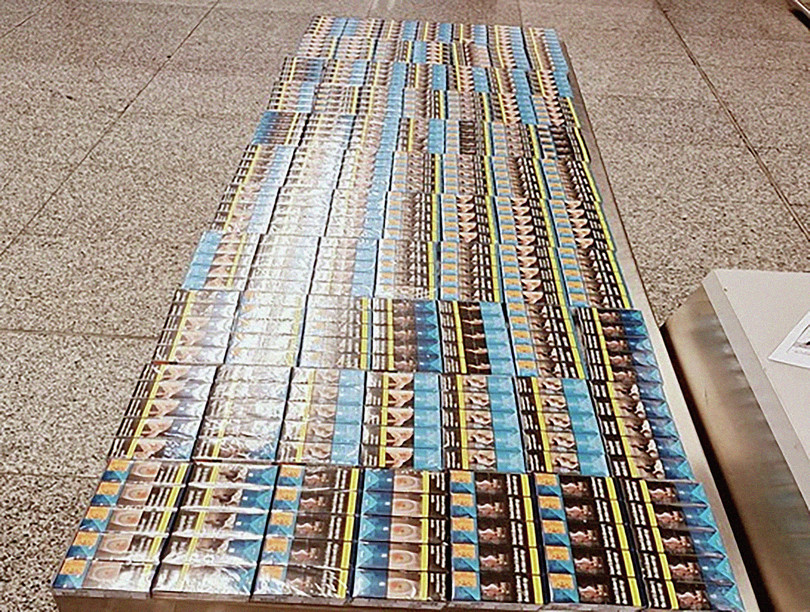
Cigarettes seized at Pristina International Airport from an Albanian woman bound for London in March 2025.
Photo: Official Kosovo Police Facebook page
Cross-border cooperation proved crucial in identifying repeat offenders. In one instance, North Macedonian authorities alerted their Kosovan counterparts about a passenger who had previously been caught smuggling cigarettes on flights from Skopje and Belgrade to London.10 When this person arrived at the airport, a search of his baggage revealed 12 cartons of cigarettes.
Increased detections at Skopje airport
There has been a long history of attempts to smuggle cigarettes from Skopje International Airport to London. One of the most notable early cases was in 2013, when border officials intercepted four passengers — all dual citizens of North Macedonia and Bulgaria — who were attempting to carry 748 cartons of cigarettes onto a flight to Luton airport. Of these, 615 had North Macedonian tax stamps, while 133 were unstamped.11
Recently, there has been an increase in detected smuggling attempts. Between January 2024 and May 2025, customs officials at Skopje airport recorded 21 separate incidents involving flights to Luton alone. Each case was uncovered during routine inspections before departure.12 Macedonian nationals and foreign citizens, including passengers from Kosovo and Romania, have been implicated, suggesting a regional trend. Customs officers intercepted a Kosovan citizen attempting to smuggle 60 cartons of cigarettes and two Romanian citizens carrying 144 cartons of cigarettes out of North Macedonia on a flight to London. The contraband was discovered during baggage checks.13
Another emerging trend at Skopje airport is an increase in the seizure of loose tobacco, which is often transported in bulk and without commercial packaging. This could be a way of evading the scrutiny directed at boxed cigarettes.14
| Year | Cases | Cartons | Loose tobacco (grams) |
|---|---|---|---|
| 2024 | 11 | 652 | 6 750 |
| 2025 | 10 | 444 | 17 460 |
Figure 3 Seizures at Skopje International Airport of tobacco destined for London.
Source: North Macedonia Customs
On 26 March 2025, authorities at Skopje airport seized the largest quantity of cigarettes in two years. During a luggage inspection, officials discovered 231 cartons of cigarettes and 1.5 kilograms of tobacco in the possession of two North Macedonian passengers travelling to London, with one of the passengers carrying 203 cartons and all of the tobacco.15
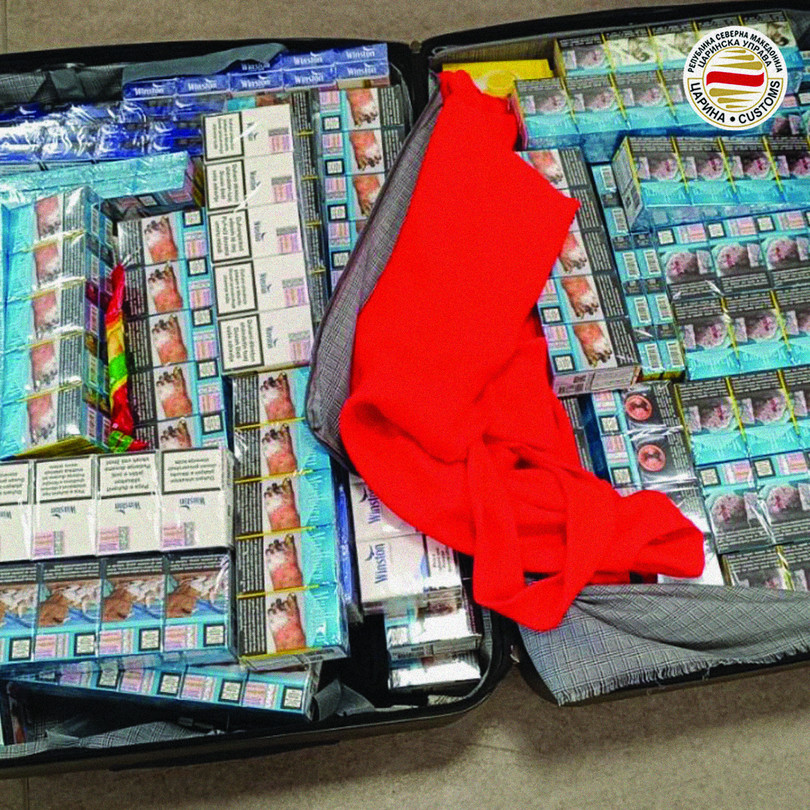
Cartons of smuggled cigarettes seized by officials at Skopje International Airport in November 2024. The products were destined for London Luton Airport.
Photo: North Macedonia Customs via Makfax
Albanian criminal networks shift to land and sea routes
On 10 June 2024, an Albanian national was arrested at Luton airport for attempting to smuggle 1 700 packs of cigarettes from Tirana International Airport in Albania. The 38-year-old suspect was stopped during a routine baggage inspection on arrival. Working in coordination with the Albanian State Police, British border officials seized the illicit cargo. The man remains in custody while the investigation continues.16
Although flights to London’s three airports, as well as to Manchester and Edinburgh, are usually cheaper from Tirana, smugglers still favour Pristina and Skopje. This is partly because intensified cooperation between the UK and Albania in tackling organized crime has resulted in heightened security at Tirana. Additionally, traffickers prefer to exploit the existing vulnerabilities at Pristina and Luton.17 Recently, however, there has also been a shift away from air travel.
In May 2025, Albania’s Special Structure Against Corruption and Organized Crime (SPAK) dismantled a large-scale cigarette smuggling network involving 36 people. The suspects are alleged to have caused around €36 million in excise and other customs losses to Albania, and over €10 million to the EU market, across just four documented cases.
At the centre of the case is a factory in Albania that allegedly operated under contract with a front company based in Dubai, and owned by a Ukrainian national. Officially, the facility produced cigarettes for export to Cyprus. However, the shipments were diverted by land to Kosovo and by sea through Italy to western EU states and the UK.18
SPAK alleges that every consignment produced by the network between 2021 and 2023 was smuggled. A total of 35 shipments were diverted from their declared routes. The factory specialized in counterfeit cigarettes, allegedly with the help of a former technician of an international brand. Production ran day and night, reportedly with the benefit of informal protection from the local police. None of the products carried fiscal stamps, and they all entered the illicit European cigarette market, either for sale there or transit to the UK.
The scheme relied heavily on systemic corruption. Several customs officials, including the deputy director general and the head of the operations department, were accused of disguising the movement of the contraband goods. Trucks were reportedly falsely recorded as having crossed the Kakavia border post into Greece.19
Most of those arrested were Albanian nationals, alongside a dual Albanian–North Macedonian national, a Kosovan representative of the Ukrainian company owner, two Serbian drivers and two North Macedonian drivers. One of the defendants also faces charges of bribing public officials.
SPAK’s findings suggest that the network operated across multiple jurisdictions, routinely exploited corrupt state structures and had direct access to lucrative illicit markets in Western Europe. SPAK described it as a highly coordinated scheme designed to defraud both national and European tax systems.20
The smuggling of cigarettes in large quantities is rarely the work of lone individuals.21 Coordinated efforts are required in both the country of origin and the destination to transport and sell the products on the black market. The pattern, quantities and methods used to smuggle cigarettes to Luton airport indicate the involvement of organized criminal networks.
Undeclared cash being moved from London to airports in the Western Balkans, especially Tirana, has been detected on multiple occasions. Money couriers travelling with sums just below the legally permitted threshold of €10 000 are also common. This suggests a pattern of two-way smuggling activity — cash flowing out of the UK and cigarettes flowing in — which would enable criminal networks to maximize their profits in both directions and cover courier fees. However, formal investigations to date have not established direct operational links between the cigarette and cash smuggling networks.
The financial incentives driving the smuggling operation are considerable. A single carton of cigarettes costs around €30 in the Western Balkans, but the same product can cost around €200 on the legitimate UK market or €70 on the black market. Therefore, the gross profit on each carton is at least 130%.
The 1 510 cartons seized in Kosovo between July 2024 and April 2025 had an estimated local market value of around €45 300.22 In the UK, their resale value on the black market would be around €105 700, representing a potential gross profit of €60 400. Meanwhile, the 1 096 cartons seized at Skopje airport and destined for Luton from January 2024 to May 2025 had a local value of around €32 800. These cartons would have been sold on the black market in the UK for around €76 720, generating a potential gross gain of €43 920.
The UK Treasury incurs significant losses in terms of excise duty and VAT on smuggled cigarettes. Had the cigarettes seized at Pristina and Skopje airports slipped through the net, the fiscal damage would have amounted to no less than €358 780 (see Figure 4).23
| Airport | Cartons | Local value | UK black market value | Potential profit | Damages to the UK |
|---|---|---|---|---|---|
| Pristina | 1 510 | €45 300 | €105 700 | €60 400 | €207 872 |
| Skopje | 1 096 | €32 800 | €76 720 | €43 920 | €150 909 |
| Total | 2 606 | €78 100 | €182 420 | €104 320 | €358 780 |
Figure 4 Potential criminal profit and tax losses from cigarettes seized at Pristina International Airport (July 2024—April 2025) and Skopje International Airport (January 2024—May 2025) destined for London airports.
Cross-border cooperation is critical to tackling smuggling
Although modern scanners and detection equipment are crucial for identifying smuggled goods, effective prevention requires cross-border cooperation. National authorities must enhance their joint intelligence gathering and risk analysis efforts to identify smuggling patterns and profile high-risk passengers. These measures must be integrated into national and bilateral operations to identify and disrupt criminal networks.
The timely exchange of information with neighbouring countries is equally important, particularly given the Western Balkans’ high degree of interconnectedness, as well as with destination markets like the UK. The authorities in both regions should also intensify their cooperation to investigate the links between cigarette smuggling into the UK and the outflow of cash to the Western Balkans by transnational criminal networks.
Notes
-
Interview with customs officials, Pristina, 21 May 2025. ↩
-
Kosovo Customs, Statistics for smuggling of cigarettes from Pristina Adem Jashari International Airport, 27 May 2025, email. ↩
-
Ibid. ↩
-
Interviews with police and customs officials, Pristina, 21 May 2025. ↩
-
Kosovo Customs, Statistics for smuggling of cigarettes from Pristina Adem Jashari International Airport, 27 May 2025, email. ↩
-
Interviews with police and customs officials, Pristina, 21 May 2025. ↩
-
Ibid. ↩
-
Kosovo Police, Në aeroport sekuestrohen disa pako me cigare, 4 March 2025. ↩
-
Arton Hamiti, Parandalohet kontrabandimi i 200 pakove me cigare në Aeroportin e Prishtinës, Kallxo, 18 April 2025. ↩
-
Ibid. ↩
-
Спречен шверц на 750 штеки цигари од Македонија во Велика Британија, Makfax, 17 September 2013. ↩
-
North Macedonia Customs, Statistics on smuggling of cigarettes from Skopje International Airport, 27 May 2025, email. ↩
-
(Видео) Спречени обиди за шверц на кокаин, цигари, офталмолошки производи, облека и друга стока објави Скопје1.мк, Skopje1.mk, 12 November 2024; Спречени обиди за криумчарење на лекови, медицински игли, тутун, облека и обувки, Republika, 21 January 2025. ↩
-
Ibid. ↩
-
Шверцери паднаа со пари, парфеми, оружје и цигари – Царината фати двајца патници со 231 штека, Plusinfo.mk, 27 March 2025. ↩
-
Albanian State Police, Policia e Shtetit – finalizohet operacioni policor i koduar ‘Paketa’, 10 June 2024. ↩
-
Interviews with police and customs officials, Pristina, 21 May 2025. ↩
-
SPAK, Decision on security measures, 27 May 2025, (unpublished); Edmond Hoxhaj and Vladimir Karaj, Zyrtarët e Doganave shqiptare i hapën traun biznesit të kontrabandës së cigareve, Reporter, 12 June 2025. ↩
-
Ibid. ↩
-
SPAK, SPAK godet një grup të strukturuar kriminal për kontrabandë cigaresh, 36 persona nën hetim, 28 May 2025. ↩
-
Albania’s General Customs Directorate, Freedom of Information Act request response, 9 June 2025, email. ↩
-
The calculation is based on the brand and the local price. In Kosovo, 93% of seized cigarettes were different types of Marlboro. These are sold at approximately €3 per packet or €30 per carton. In London, UK, the average price of a packet of Marlboro cigarettes is around £16.80 (€20). ↩
-
The calculation is based on a cost of £446.67 for 1 000 cigarettes, assuming a retail price of £16 incorporating 20% VAT. See Gov.uk, Guidance: Tobacco products duty, 3 April 2025. The conversion from British pounds to euros was made on 9 June 2025. ↩