Bosnia and Herzegovina faces cannabis cultivation challenges.
Authorities in Bosnia and Herzegovina seized more than 5 tonnes of various drugs in raids across the country’s three geographic entities in 2024, a significant portion of which comprised cannabis seizures. Across Bosnia and Herzegovina, roughly 97% of the drugs seized in 2024 were cannabis or cannabis plants. Most of it, over 3.1 tonnes, was confiscated by the Federal Police Unit, with additional seizures made by the Border Police, Brčko District Police and the Republic of Srpska Ministry of Interior. These operations, including several with international scope, dismantled multiple organized crime groups and uncovered 11 drug production laboratories, underscoring intensified efforts to combat drug production and trafficking networks across the country. Synthetic drugs such as amphetamines and ecstasy made up a smaller, but still notable, portion of the total seizures.1
According to the latest security report published in 2023 by Bosnia’s Ministry of Security, the country remains primarily a transit route for drugs — especially cannabis — smuggled from Albania, mostly through Montenegro and to a lesser extent through Serbia, en route to major consumer markets in Western Europe. Although drug consumption in Bosnia and Herzegovina is rising, it remains relatively low compared to other European countries.2 Previously, domestic drug production was largely limited to small-scale cultivation of cannabis, both outdoors and in improvised indoor laboratories, which allows for year-round harvesting. The historical volume of cannabis plants seizures suggests that these were minor plantations until 2021, when a significant up-trend became apparent alongside seizures.3
Cultivation continues to be concentrated in areas with a Mediterranean climate, notably in the Herzegovina region of southern Bosnia and Herzegovina. In just a few days in June and July 2025, over 110 plants were seized in Čapljina and Čitluk, located 20 kilometres apart in south Herzegovina.4 But according to seizures, cannabis production has spread across the rest of the country, with increasing use of makeshift outdoor laboratories and even indoor setups in apartments, warehouses, basements and other similar locations.5
One of the earliest and largest cannabis seizures from outdoor cultivation in Bosnia and Herzegovina was in 2013, when around 1 tonne of domestically grown cannabis was seized in a forest near Laktaši in the Republic of Srpska. This was an early example of large-scale cannabis cultivation, but still represented an isolated occurrence.6 One major operation in 2024 brought the second-largest ever seizure of cannabis plants cultivated outdoors (3 000), worth €1.5 million. This seizure took place in Bihać, a town bordering Croatia in the west of Bosnia and Herzegovina.7 Interestingly, criminals often cultivate cannabis in minefields, exploiting local knowledge of these areas in a context where law enforcement lacks the equipment to navigate safely.8
Between 2021 and 2025 there appears to have been a notable increase in outdoor cultivation, as seen in the outcomes of several major law enforcement operations. One of these, a police operation code-named Escobar conducted in Velika Kladuša in 2021, resulted in over 6 000 cannabis plants being seized along with more than 5 kilograms of cannabis and cultivation equipment, leading to the arrest of four individuals. Authorities stated that the drugs were intended for both the domestic market and distribution to EU countries, underscoring the transnational dimension of the operation.9
While outdoor cultivation appears to be increasing, indoor cultivation has also experienced rapid growth across the country, reflecting growing demand and profitability within the domestic market. For example, in Sarajevo Canton, houses and apartments are being rented and adapted into laboratories for indoor cultivation of cannabis.10 In March and April 2025, one of the largest law enforcement operations yet, code-named Koko, led to the arrest of 10 men aged between 30 and 40. Police uncovered two extensive indoor cannabis laboratories that were cultivating a combined total of around 1 000 plants; they also seized more than 30 kilograms of cannabis and synthetic drugs with a total value estimated of more than €500 000.11
Despite the apparent rise in both indoor and outdoor cannabis cultivation across Bosnia and Herzegovina, certain areas show a worrying lack of enforcement results. For example, no cannabis seizures were recorded in Tuzla Canton and Brčko District in 2023, indicating potential gaps in detection, resource allocation, or investigative priorities.12
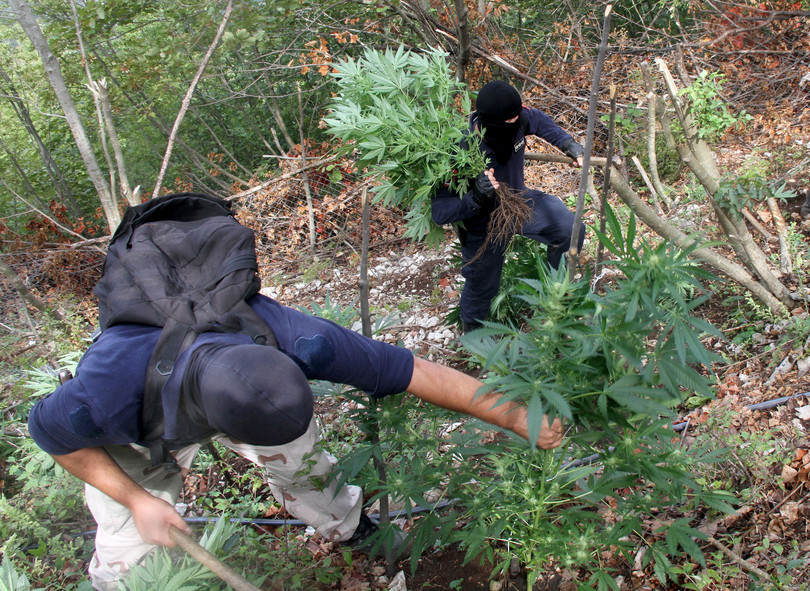
Albanian police destroy a field of cannabis plants. Bosnia and Herzegovina remains a main transit country for cannabis from Albania, but production is now also spreading across the country.
Photo: Gent Shkullaku/AFP via Getty Images
Rising criminality and shifting role in the region
Bosnia and Herzegovina has transitioned from primarily a transit country to both a source and destination for cannabis. It remains the most used and seized drug, with trafficking routes originating in Albania, passing through Montenegro or Serbia and extending toward Western Europe. Moreover, there are growing reports of indoor cannabis cultivation, particularly in the southern and western parts of the country, including the production of sour cannabis, a more potent variety. This shift has coincided with a rise in violent confrontations among criminal networks vying for market control, indicating an increasingly competitive and volatile illicit drug landscape.13
Law enforcement indicates that cannabis trafficking remains a highly lucrative criminal activity. Current data suggest that the street price of cannabis ranges between €7 and €10 per gram, while bulk prices range from €1 200 to €2 000 per kilogram. These profit margins continue to drive production, distribution and cross-border trafficking, particularly within well-organized criminal networks operating across the Western Balkans.14 Additionally, the Republic of Srpska’s Ministry of Interior highlights that recent police operations have produced notable results, driven by intelligence derived from deciphering communications on encrypted messaging platforms ANOM and SkyECC. These efforts have revealed various trafficking techniques, operational plans and more individuals involved in drug smuggling.15
Decrypting the Sky app enabled the prosecution of key drug trafficking figures in Bosnia and Herzegovina. Between December 2022 and July 2024, eight separate indictments related to encrypted Sky and ANOM messaging platforms were filed at the Court of Bosnia and Herzegovina, exposing large-scale organized criminal networks involved in trafficking drugs, including cannabis and cocaine. Digital evidence from Sky and ANOM have been used to substantiate trafficking charges and secure multiple plea agreements and convictions.16
Cannabis consumption and institutional response
Since the early 2000s, there has been a significant increase in both cannabis production and trafficking. Law enforcement agencies lacked proper coordination and inter-agency cooperation remained weak, allowing criminals to expand their illegal cannabis operations.17
According to European Union Drugs Agency data for Bosnia and Herzegovina from 2019, the average age of first cannabis use was 20, while overall consumption rates remain relatively low compared to other European countries.18 However, the data indicates a significant level of frequent cannabis use among existing users across both genders and regions. For example, over a 30-day period, 43% of men reported using cannabis daily or nearly every day, while 52% of women reported consuming it several times week. In terms of regional trends, Bosnia and Herzegovina as a whole recorded a slightly higher rate of daily use (33%) compared to the Republic of Srpska (28%), pointing to a concerning pattern of regular consumption among the surveyed population.19
As part of its institutional response to the growing challenges of drug use and trafficking, the Sarajevo Canton has adopted a strategy for the prevention of drug abuse covering the period 2024 to 2028. This strategic document serves as a comprehensive policy framework designed to reduce drug demand, prevent addiction and enhance law enforcement and public health responses. The strategy was developed through an inclusive working group process that engaged relevant institutions, civil society actors and independent experts, including the GI‑TOC. The strategy outlines key priorities including prevention in schools, early intervention, inter-agency coordination and support for recovery and reintegration, reflecting a balanced and sustainable approach to addressing drug-related consequences in the canton.20
Scaling up the policy response
Civil society’s role in shaping prevention programmes, promoting community resilience and ensuring transparency is key to a long-term and sustainable impact. Going forward, scaling up such approaches from the cantonal level to the national level and investing in stronger data systems, cross-agency cooperation and community-led responses will be essential to containing the expansion of illicit cannabis cultivation and its related harms.
Notes
-
Droga preplavila BiH: U 2024. zaplijenjeno više od pet tona narkotika, otkrivene laboratorije i plantaže, Etto, 26 May 2025. ↩
-
Ministry of Security of BiH, Information on security in Bosnia and Herzegovina for 2022, 2 July 2024. ↩
-
Ibid. ↩
-
Akcija FUP-a: Otkrivena plantaža marihuane kod Čapljine, Pogled, 7 July 2025; Policija otkrila 63 stabljike marihuane kod Čitluka, osumnjičeni zatečen pri zalijevanju, Hercegovina Info, 28 June 2025. ↩
-
Interview with a senior law enforcement representative in Sarajevo, 7 May 2025. ↩
-
Nikola Morača, Rekordna zapljena skanka u Miloševcima, kod Laktaša, Nezavisne, 2 October 2013. ↩
-
Borka Cerić, Nakon pronalska 3.000 stabljika kanabisa: Čija je marihuana vrijedna tri miliona KM?, Avaz, 20 August 2024. ↩
-
Interview with a senior law enforcement representative in Tuzla, 9 April 2025. ↩
-
Akcija „Escobar“: U Velikoj Kladuši zaplijenjena velika količina droge namijenjene i tržištu EU, uhapšene četiri osobe, Avaz, 25 July 2021. ↩
-
Interview with a senior inspector in Sarajevo, 10 June 2025. ↩
-
Poznat identitet uhapšenih Sarajlija: Kod njih pronađena droga vrijedna preko milion KM, Oslobođenje, 4 April 2025; Ministry of Interior of Sarajevo Canton, Akcija „Koko II“: Pronađena droga milionske vrijednosti, uhapšena tri muškarca, 3 April 2025; Sarajevo: U velikoj akciji policije uhapšeno sedam osoba, zaplijenjena droga, oružje, novac, automobil, Klix, 12 March 2025. ↩
-
Interview with the Ministry of Interior of Tuzla Canton and Police Brčko District, 14 July 2024, by email. ↩
-
GI‑TOC, Organized Crime Index 2023, Profile of Bosnia and Herzegovina. ↩
-
Interview with the Federal Police Unit, 23 July 2025, by email. ↩
-
Interview with the Ministry of Interior of Republic of Srpska, 25 July 2025, by email. ↩
-
Sky i Anom su dovele do osam optužnica na Sudu BiH: Ovo su imena akcija, optuženih i osuđenih osoba, N1 BiH, 23 May 2024. ↩
-
Interview with a retired senior police inspector in Mostar, 16 June 2025. ↩
-
Ministry of Security of BiH, Drug abuse among general population in Bosnia and Herzegovina 2018, 8 November 2018. ↩
-
Ibid. ↩
-
Ministry of Interior Affairs of Sarajevo Canton, Strategy and Action Plan for the Prevention and Suppression of Narcotic Drug Abuse in Canton Sarajevo for the Period 2024–2028, 1 January 2024. ↩